About Petra Ina Pfefferle
"From chemistry to biology to medicine—despite my enduring love for artistic and craft-based activities, I decided to become a scientist. My initial motivation was my enthusiasm for colors, whether produced chemically or organically—later, it was my curiosity to understand how nature works and creates such magnificent plays of color. Thus, a whole new world opened up for me, first in chemistry and then in biology. Research into living organisms continues to fascinate me to this day and never ceases to spark my curiosity. Later, as a scientist in medical research, I became convinced that a knowledge-based understanding of human physiology leads to maintaining health and healing people. Today I know that realizing one’s own potential, curiosity, and the joy of one’s own creative work should never cease—they keep us healthy and active. Because “Without health, everything is nothing!” (Aaron Antonovsky).
With each of my paintings, I sit before a blank canvas and an abundance of colors. As a scientist, I could calculate just how many possibilities are now open to me for creating a new work of art. There would be almost an infinite number.
My Story
Even as a small child, bright colors fascinated me. I collected everything that was colorful: the intensely colored transparent papers in which the oval fish cans were wrapped, colorful ground glass shards, candy wrappers and wrapping paper, and many other colorful things. I kept my treasure in a small box under the bed and always secretly admired my finds. The world in the sixties was not as colorful as today's, colors were luxury and many things were gray in gray. In my treasure chest, however, I could revel in a colorful world. The joy of the rainbow of colors accompanies me to this day.
My Motivation
As an artist I do not create representationally, but create from my thoughts, emotions and imagination something new, unseen. What I recognize in the pictures, I work out artfully, so that others also discover it for themselves. Therefore, I develop my acrylic flow technique methodically to always create something new.
My Technique
Coming from a watercolor background, the acrylic pouring technique opened up entirely new possibilities for me in terms of form and color design. Depending on their transparency and the specific pigment components, colors can be glazed with feather-light delicacy, juxtaposed to create high contrast, or transformed into flowing color gradients. The result is organic structures and interplays of form and color—not through brushstrokes, but through a pouring technique, with these interplays artistically shaped using a palette knife and other tools.
Wellenreiter - But it is the artistic shaping of the pouring process—"surfing the pouring wave," so to speak—that truly makes acrylic pouring a creative process for me. To control the flow of paint and create the resulting forms, I draw on my knowledge of physical chemistry and my technical skill, seasoned with creative flair. Thus, as the painting takes shape, a dialogue develops between the paint flowing across the canvas and my artistic hand. Recognizing these forms is what defines this creative process.
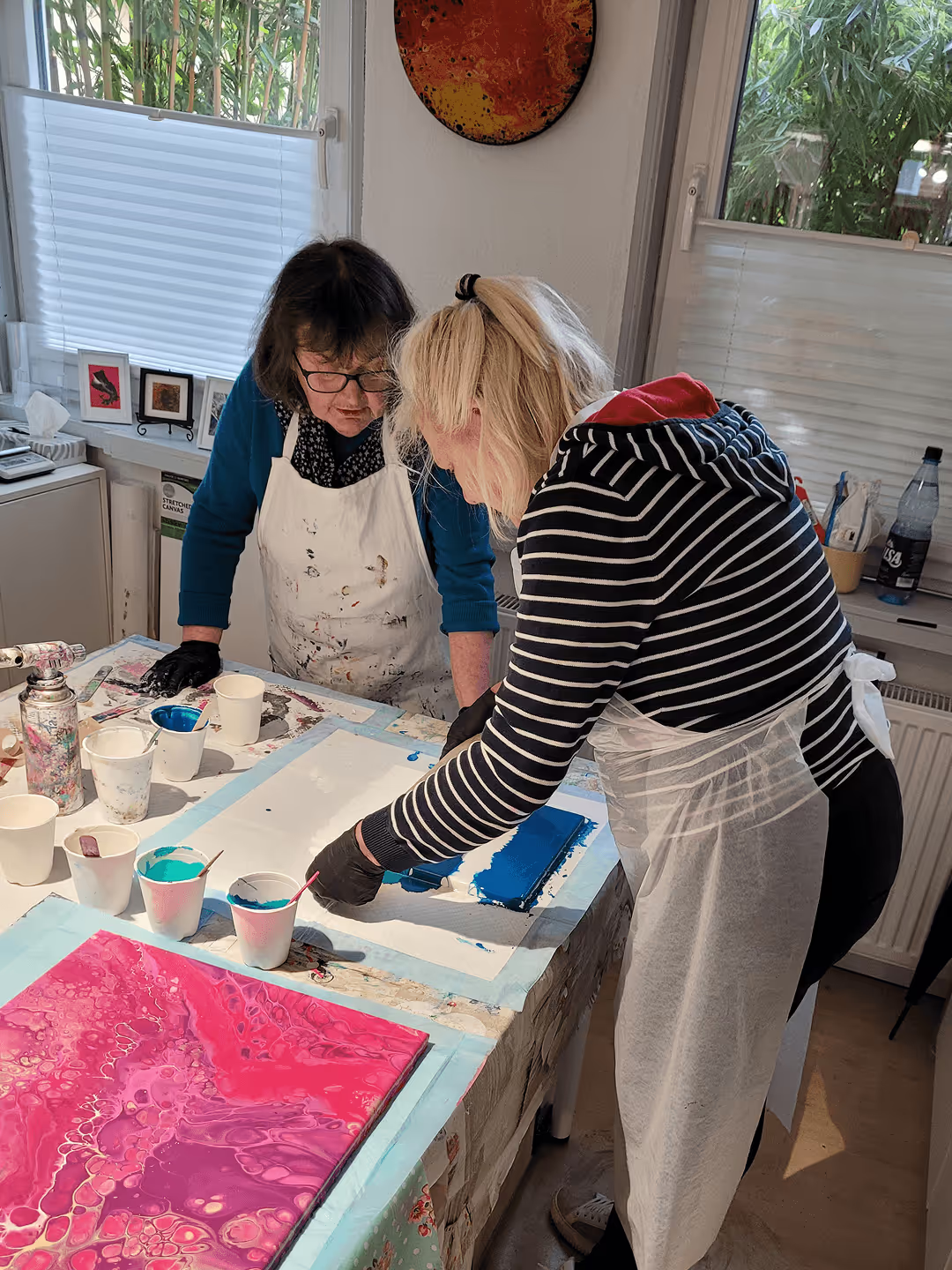
A Day in the Studio
Motifs
Every day I come across inspiring scenes that take root as images in my mind. Some of them linger and transform in my mind’s eye into “my painting.” From that point on, the creative process takes hold of me, because the image wants to be on the canvas.
Materials
What colors and materials will I use, and what technique will I employ to create the painting? What new artistic effects do I want to achieve? I experiment with the materials on small tiles or canvases until I find the right technique to bring the image in my mind to life on the canvas.
Mixture
Much like a chef who compiles the ingredient list for his dishes and meticulously prepares the ingredients, I carefully coordinate the colors. In a second step, I transform the pasty paint into fluid color emulsions so that, on the canvas, they flow together at the interfaces, overlap, and intertwine.
Pouring
While pouring, I use spatulas, marbles, or combs to give the colors a dynamic texture. This creates vibrant forms in which the viewer’s eye discovers familiar motifs. A final coat of varnish ensures that the work retains its luminosity forever.



.jpg)


